Precision Machined Steel Fabrications, Built to Print
Part Machining, Welding, Stress Relief, Corrosion Protection and Assembly
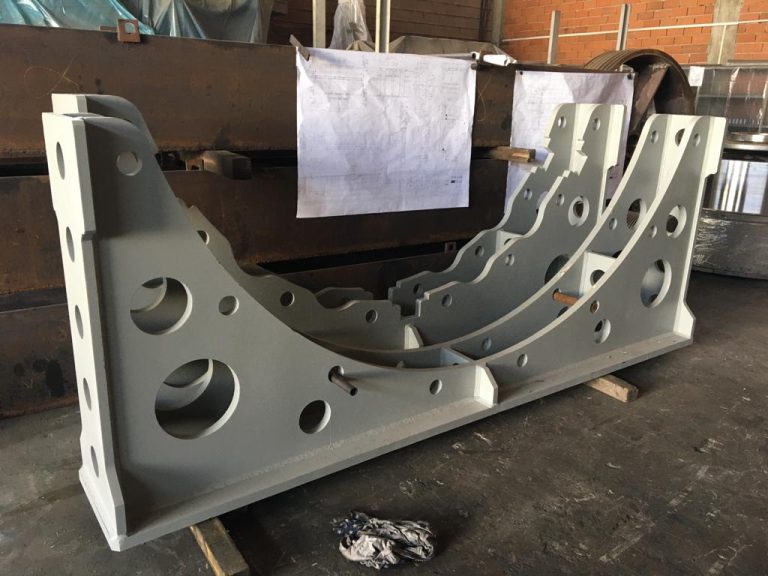
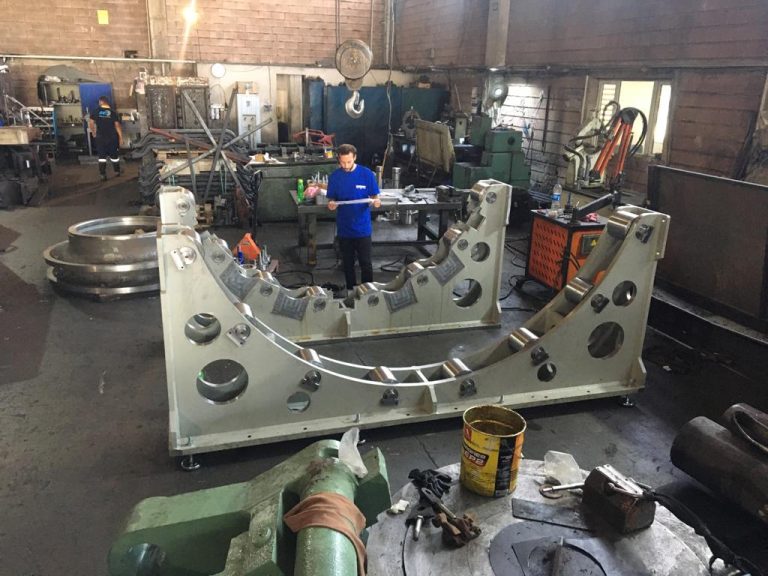
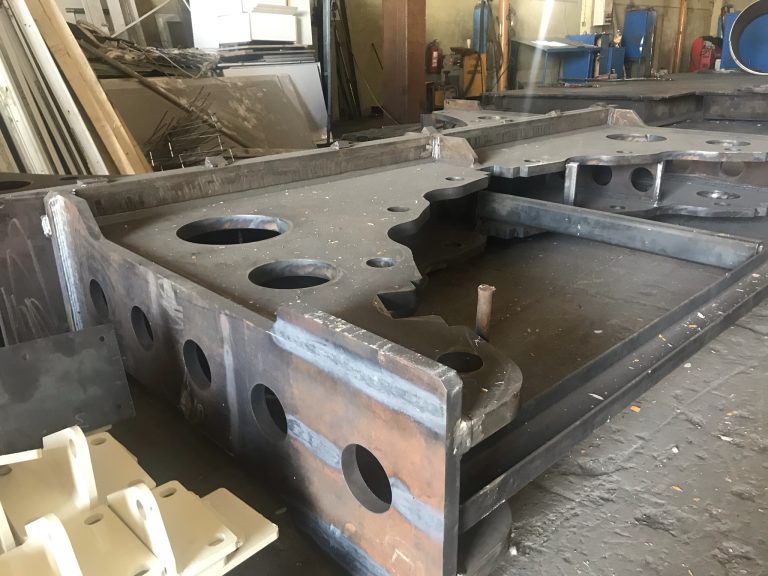
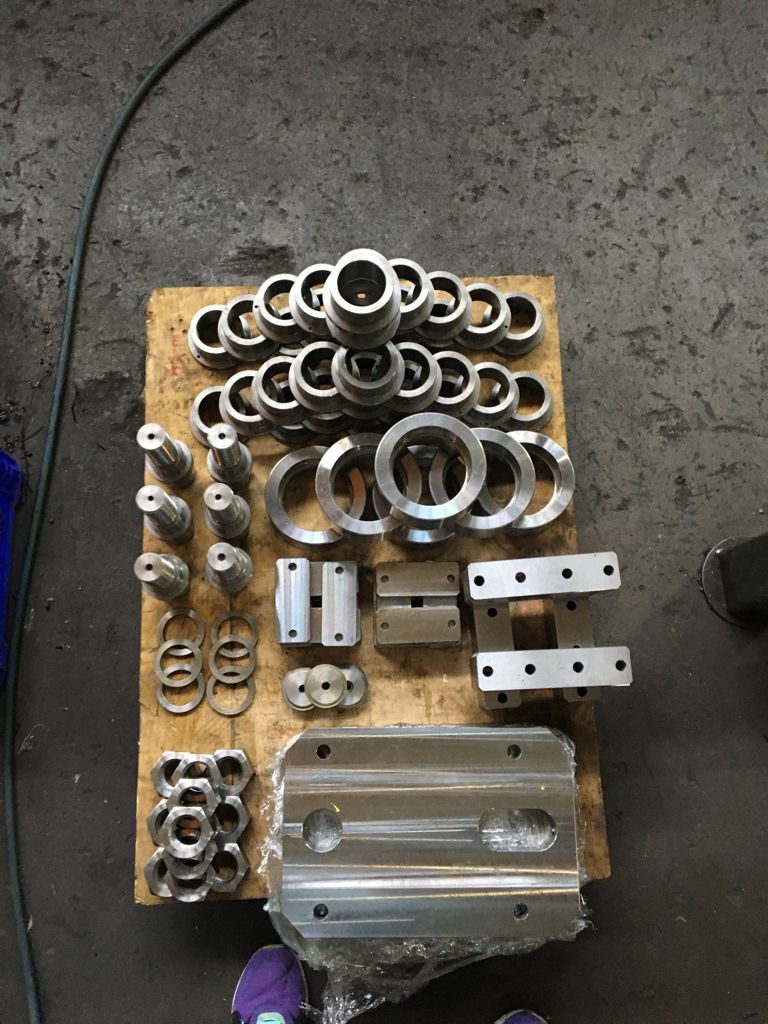
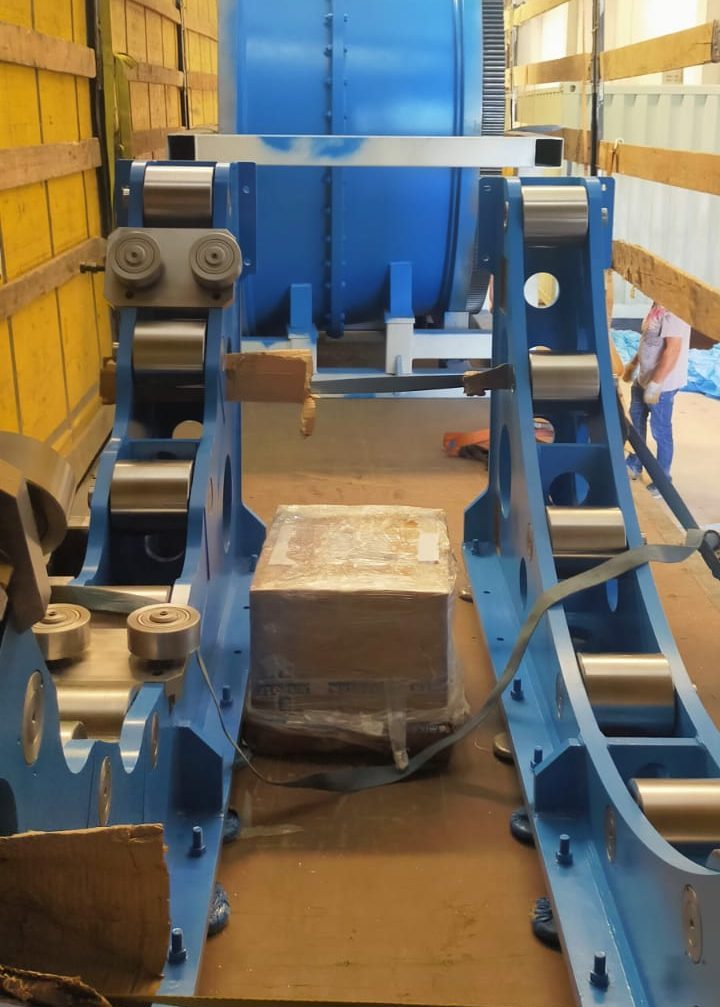
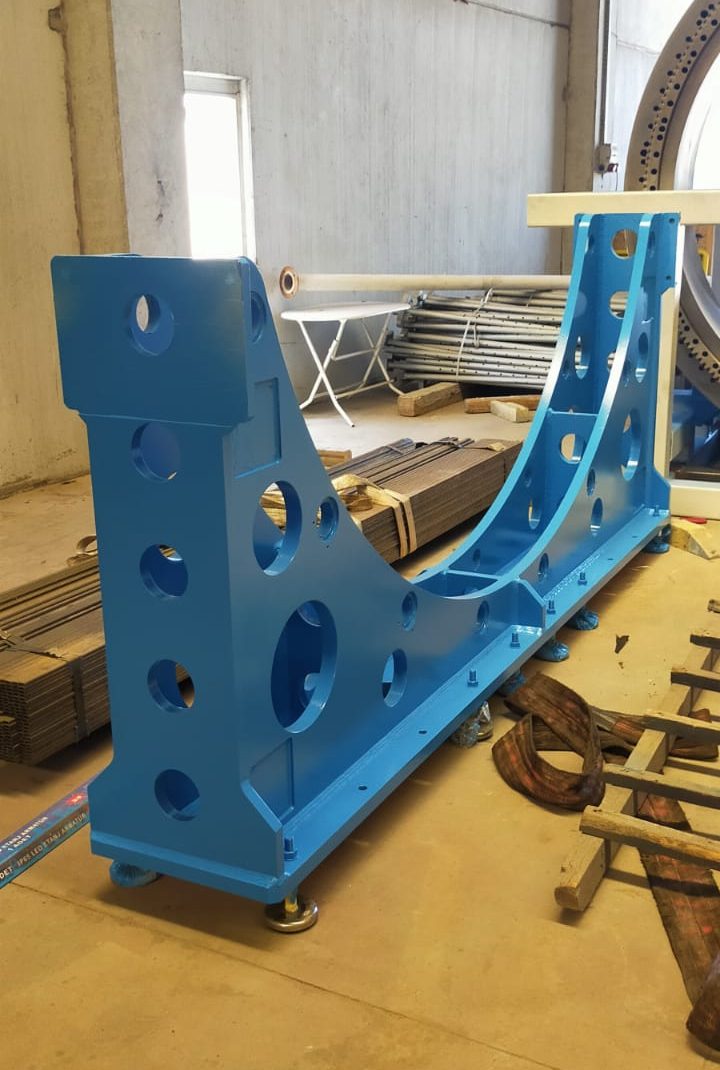
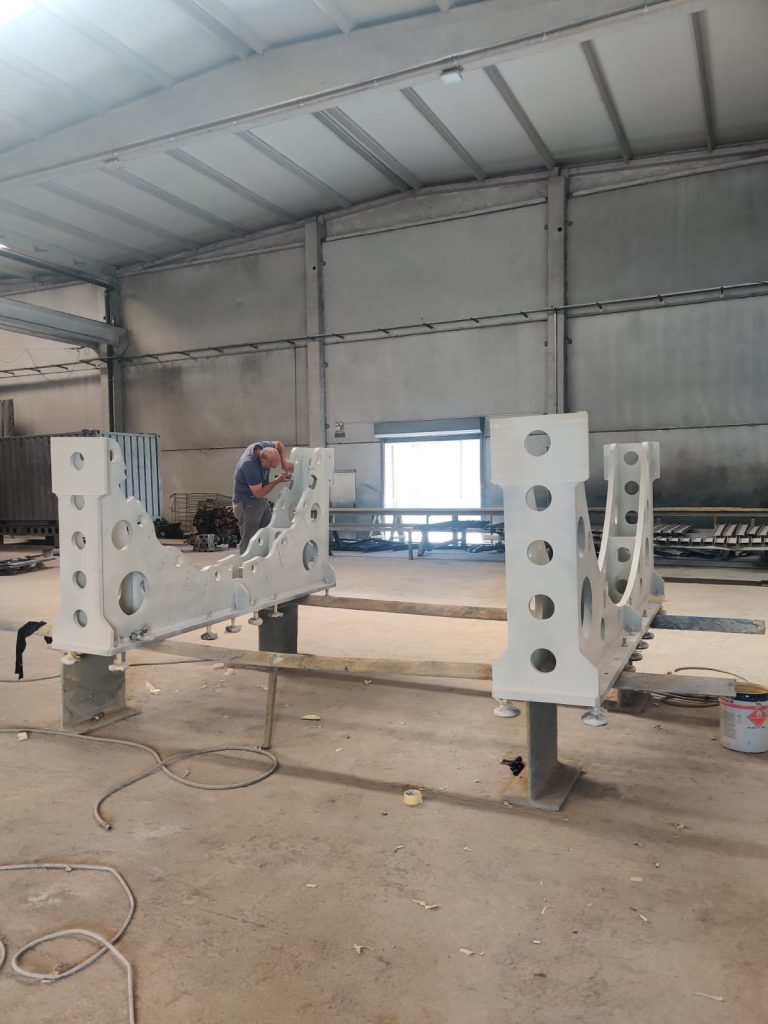
We manufacture precision machined steel fabrications: large welded assemblies in which every part is machined to your drawing, joined by controlled welding, stress-relieved, finished and assembled by our own team. The example on this page is a machine support frame, about 3.3 metres long and 1.3 metres high, weighing around 1.6 tonnes, made from 30-40 mm S355J2 plate. It has a large curved seat, precision-bored holes with H7 fits, big round openings, and rows of mounting and threaded holes, all positioned to tight tolerances.
A part like this is not simply a welded structure. It is a machined mechanical component. The individual plates are cut and machined before welding, the frame is welded and stress-relieved so it keeps its shape, critical features are brought to final size, and the whole piece is sandblasted, primed, painted and assembled with the fittings your drawing calls for before it ships.
This page is for companies looking for a build-to-print manufacturing partner for large machined and welded parts: machine builders, OEMs and system integrators. You send the drawing, and we take the part from raw plate to a finished, painted, assembled component, with one point of contact and one delivery.
The heavy machining for this project was done at our family group’s plant in Kemalpaşa, İzmir. Nika Steelworks managed the order from quotation to delivery.
Precision Machined Steel Fabrications: Technical Overview
Built to your drawing| Product | Precision machined and welded steel component (machine support frame), manufactured to print |
|---|---|
| Example size (L × W × H) | About 3350 × 500 × 1310 mm. Other sizes on request. |
| Example weight | About 1.6 tonnes |
| Material | S355J2 structural steel plate, 30-40 mm in this example. Other grades on request. |
| Construction | Individually machined plates welded into a rigid frame with curved seat, side plates and base plate |
| Machined features |
|
| Tolerances | H7 fits on precision bores. Flatness, parallelism and position held to hundredths of a millimetre on critical faces. General tolerances per ISO 2768. |
| Process chain |
|
| Corrosion protection | Sandblasted, primed and painted. Machined fits protected. Galvanizing and other coatings on request. |
| Inspection | Dimensional inspection against the drawing and weld inspection. Dye penetrant testing of welds on request. |
| Production | One-off components, small batches and series |
| Industries |
|
| Input data | 2D drawings and 3D CAD models (STEP) |
| What we need to quote | Drawings, material, tolerances, surface treatment, quantity and delivery location |
Send us your drawings and we’ll come back with a quote.
Request a quoteMachined Steel Fabrications Built to Print
Many machines depend on one large steel component that has to be both strong and exact: a support frame, a machine base, a housing, a saddle or a holder. These parts carry heavy loads, but they also locate bearings, guides, drives and tooling, so their bores, faces and hole patterns have to sit in precisely the right place. At Nika Steelworks we manufacture these precision machined steel fabrications, also called machined weldments, to our customers’ drawings. We handle the whole chain ourselves: cutting the plate, machining the individual parts, welding, stress relief, finish machining, sandblasting, corrosion protection, priming, painting and final assembly.
If you are looking for a manufacturing partner for welded and machined steel components, you do not have to coordinate a cutting shop, a welding shop, a machine shop, a paint shop and an assembler. You send the drawing and receive a finished component.
Why a Machined Weldment Instead of a Casting or a Solid Part?
A welded and machined assembly has several practical advantages over a casting or a part machined from solid. There is no pattern or tooling cost, so it suits one-off parts and small series. Design changes are easy to make between units, because the structure is built from plate and not from a mould. Plate thickness can be placed exactly where the loads are, which gives a stiff part without wasted material. And when the part is large, as it is in heavy machine building, a fabricated frame is often faster to deliver than a casting, and cheaper than machining the same shape from a block.
The trade-off is accuracy: welding heats and distorts steel. That is why the process order, the stress relief and the machining strategy matter as much as the welding itself.
Our Process: From Plate to Finished, Assembled Component
- Drawing review. We check the drawing, tolerances, material and surface treatment before work starts, and raise any questions that affect manufacturability.
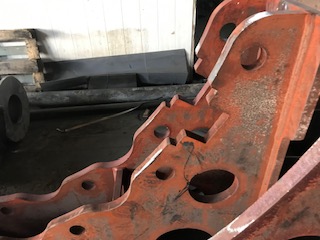
- Plate cutting. Plates are cut to shape by laser or plasma cutting, including openings and holes, with machining allowance left where the drawing calls for machined surfaces.
- Machining of individual parts. Plates and sub-parts are machined before welding: mating faces, edges, bores and seats that are easier to reach on a single part than on a finished frame.
- Fit-up and welding. Parts are positioned and welded in a controlled sequence to keep the frame square and limit distortion (welding and fabrication).
- Post-weld stress relief. The welded frame is heat-treated to relieve the stresses left by welding, so it keeps its shape during machining and in service.
- Finish machining. Critical features such as bores, seats, mounting faces and hole patterns are machined to final size after stress relief, on our CNC machines.
- Sandblasting. The structure is blasted to remove scale, rust and weld spatter, and to give the coating a surface it can bond to (sandblasting and paint).
- Corrosion protection, priming and painting. A primer goes on soon after blasting, followed by the topcoat in the colour you specify. Machined fits and threaded holes are protected so the coating does not change their size.
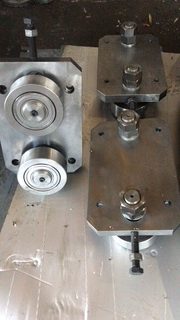
- Assembly and inspection. The fittings your drawing specifies are installed, the component is checked against the drawing, and it is packed for transport.
Why Stress Relief Matters for Welded, Machined Parts
When a frame is welded, the weld areas heat up and cool down unevenly, which locks stress into the structure. If a part is machined in that state, the stress can release as material is removed, and the part moves. The same can happen in service, after the machine is running. Post-weld stress relief heats the frame to a controlled temperature, holds it, and cools it slowly, which reduces those residual stresses. Performing the finish machining after stress relief gives much more stable dimensions, which is why we treat it as a standard step for precision frames and not as an extra.
Precision Machining of Large Welded Parts
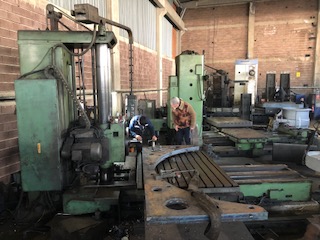
Machining large parts is a different task from machining small ones. The workpiece has to be supported so that its own weight does not distort it, clamped without stressing it, and machined in an order that keeps the surfaces related to one another. On parts like the support frame shown here, we machine precision bores to H7 fits, curved seats and faces to flatness, parallelism and position tolerances in the hundredths of a millimetre, large circular openings, and patterns of mounting and threaded holes. You can see the equipment on our machine park page. For a very large precision part we have built, see our rotary mandrel for an aerospace machine.
Corrosion Protection and Paint Systems
The coating is part of the engineering. We blast the structure, prime it, and paint it with a system matched to where the part will work: a workshop, an outdoor site or a harsh environment. For long outdoor life, galvanizing and other protective coatings are available. Tell us the environment and the service life you need, and we will recommend a system. Machined surfaces, bores and threaded holes are protected so that they stay within tolerance after coating.
Materials
The example on this page is made from S355J2 structural steel plate, 30-40 mm thick. S355 is a common choice for frames and supports because of its strength and good weldability. We also work in S235 and other structural grades, and can quote other materials on request. If your drawing calls for a specific grade or for material certificates, tell us when you request a quote.
Who We Manufacture For
- Machine builders and OEMs who need frames, bases, supports and housings made to their own drawings.
- Aerospace and special-purpose machinery manufacturers who need large, precise structural components.
- Industrial automation and production equipment companies building lines, test rigs and fixtures.
- Energy, mining and heavy equipment manufacturers who need rugged welded and machined parts.
We make one-off components, prototypes and small series, and for repeat orders we keep the setup identical so each part matches the last.
Quality, Documentation and Confidentiality
Each part is checked against the drawing, including bore sizes, hole positions, flatness and overall dimensions, and the welds are inspected. Dye penetrant testing of welds is available when the specification calls for it. If you need specific inspection reports or material certificates, mention it with your request. Read more about how we work on our quality page. We treat customer drawings as confidential and are happy to sign a non-disclosure agreement before you send them.
What to Send for a Quote
- 2D drawings and a 3D model (STEP), including tolerances
- Material and any certificate requirements
- Surface treatment: paint system, colour or coating
- Stress relief and inspection requirements
- Quantity and delivery location
More from Nika Steelworks
Learn more about Nika Steelworks or browse all our services and projects. Other work you may be interested in: custom steel containers, equipment enclosure containers and steel jacking pipes.
Frequently Asked Questions
Can you manufacture machined welded parts to our drawing?
Yes. We work build to print from 2D drawings and 3D CAD models, and handle the whole process from plate to finished, assembled part.
Do you machine the parts after welding?
Critical features are finish-machined after welding and stress relief, so that the final dimensions are not affected by weld distortion.
Do you offer stress relief?
Yes. Post-weld stress relief is part of our process for precision frames and supports.
What tolerances can you hold?
We machine precision bores to H7 and hold flatness, parallelism and position tolerances in the hundredths of a millimetre on critical faces, according to the drawing.
How are the parts protected against corrosion?
They are sandblasted, primed and painted, and we also galvanize or apply other coatings on request.
What sizes and weights can you handle?
The example here is about 3.3 metres long and 1.6 tonnes. Send us your dimensions and weights and we will confirm what is possible.
Do you make single parts or series?
Both. We make one-off parts, prototypes and small series.
Request a Quote for Precision Machined Steel Fabrications
Send us your drawings, material, tolerances, surface treatment, quantity and delivery location, and we will come back with a clear quote. Contact Nika Steelworks to get started.